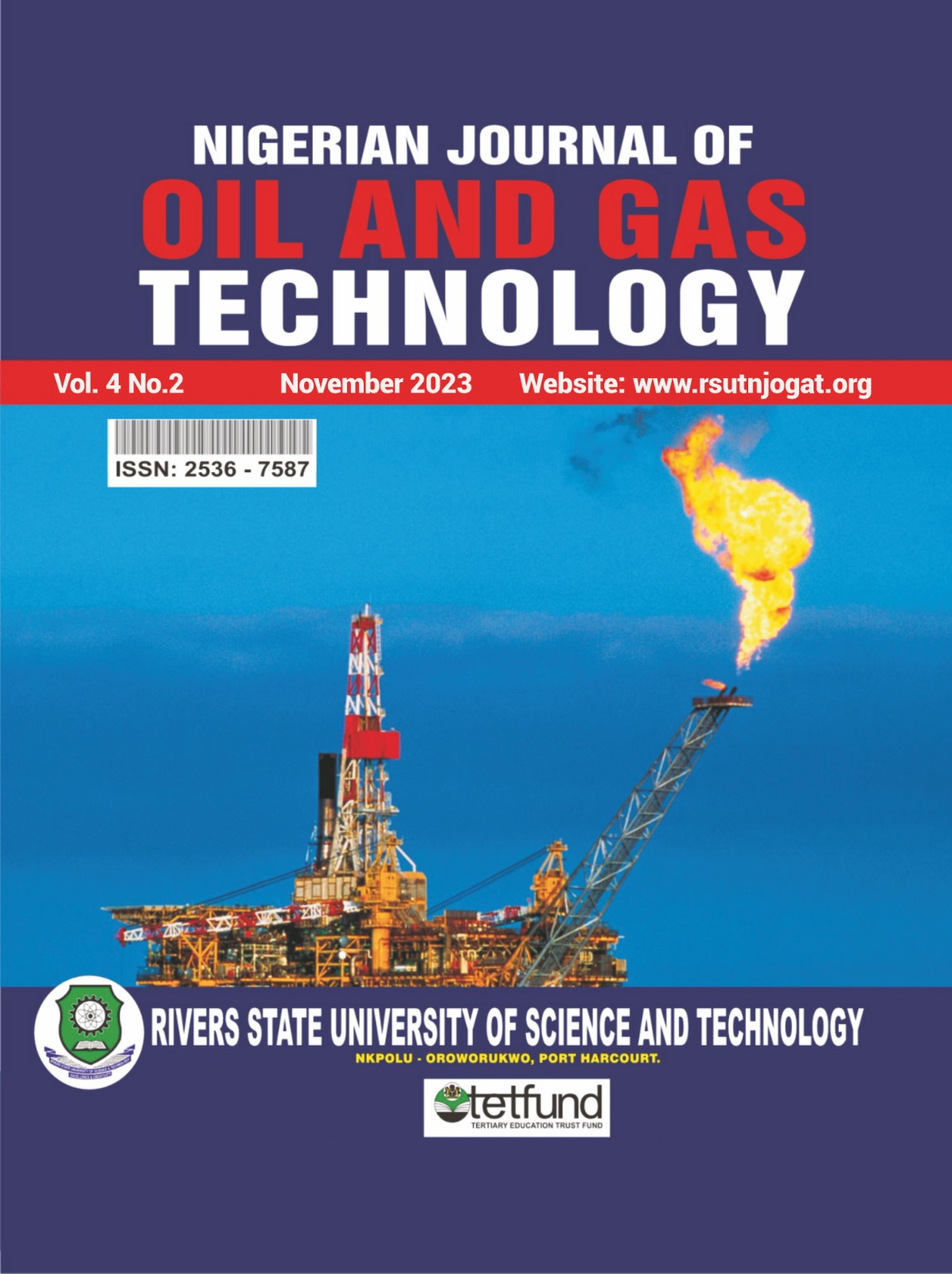
Health, Safety and Environment Training and Employee Job Performance in Indigenous Oil and Gas Companies in Rivers State
Аннотация
This study examined the relationship between health, safety and environment training and employee job performance in indigenous oil and gas companies in Rivers State. The study adopted the cross-sectional research survey design. Primary source was generated through structured administered questionnaire. For the purpose of data collation ten (10) indigenous oil and gas companies were selected for this study with 387 respondents. The sample size of 197 was calculated using the Taro Yamane sample size determination formula. The reliability of the instrument was achieved by the use of the Cronbach Alpha coefficient with all the items scoring above 0.70 to be selected. Data generated was analysed and presented using both descriptive and inferential statistical techniques. The hypotheses were tested using the Spearman’s Rank Order Correlation Statistics. The findings revealed that there is a significant relationship between health, safety and environment training and employee job performance in indigenous oil and gas companies in Rivers State. In conclusion, the study provides evidence of a positive and significant relationship between HSE (Health, Safety, and Environment) training and employee job performance in indigenous oil and gas companies in Rivers State. Therefore, the study recommends that managers in Indigenous oil and gas companies in Rivers State should invest in enhancing their HSE training programs. This includes incorporating relevant and up-to-date content, using interactive and practical training methods, and ensuring the training is tailored to the specific tasks and challenges faced by employees in the industry. Regularly reviewing and updating training materials based on industry best practices and regulatory requirements is crucial for maximizing the effectiveness of HSE training.
Скачивания
Библиографические ссылки
Abas, N. H., Yusuf, N., Rahmat, M. H., & Tong, Y. G. (2021). Safety personnel's perceptions on the significant factors that affect construction projects safety performance. International Journal of Integrated Engineering, 13(3), 1–8.
Abaya, P. M., Diang’a, A. S., & Gwaya, Q. A. (2021). Factors affecting occupational safety and health compliance on construction sites in Kiambu County, Kenya. International Journal of Engineering Research & Technology (IJERT), 10(8), 512–519.
Aboagye, A. K., Dai, B., & Bakpa, E. K. (2020). The effect of risk communication on the nurses' task and contextual performance in disease outbreak control in Ghana: Application of the cause model. The International Journal of Health Planning and Management, 35(4), 922–938.
Adim, C. V., & Mezeh, A. A. (2020). Health and safety training and employee performance in oil and gas companies in Rivers State, Nigeria. British International Journal of Education and Social Sciences, 7(8), 41–50.
Al Karim, R. (2019). Impact of different training and development programs on employee performance in Bangladesh perspective. International Journal of Entrepreneurial Research, 2(1), 8–14.
Albrahim, F. A. (2020). Online teaching skills and competencies. Turkish Online Journal of Educational Technology-TOJET, 19(1), 9–20.
Armstrong, M. (2012). Armstrong's handbook of human resource management practice. Kogan Page Publishers.
Balogun, A. O., Andel, S. A., & Smith, T. D. (2020). Digging deeper into the relationship between safety climate and turnover intention among stone, sand and gravel mine workers: Job satisfaction as a mediator. International Journal of Environmental Research and Public Health, 17(6), 1925.
Casey, T., Turner, N., Hu, X., & Bancroft, K. (2021). Making safety training stickier: A richer model of safety training engagement and transfer. Journal of Safety Research, 78, 303–313.
Dahl, Ø., Rundmo, T., & Olsen, E. (2022). The impact of business leaders’ formal health and safety training on the establishment of robust occupational safety and health management systems: Three studies based on data from labour inspections. International Journal of Environmental Research and Public Health, 19(3), 1269.
Gungor, O., Sen, S., Kircelli, F., Yilmaz, M., Sarsik, B., Ozkahya, M., ... & Toz, H. (2011, April). Plasmapheresis therapy in renal transplant patients: Five-year experience. In Transplantation proceedings (Vol. 43, No. 3, pp. 853–857). Elsevier.
Harrison, D. A., Newman, D. A., & Roth, P. L. (2006). How important are job attitudes? Meta-analytic comparisons of integrative behavioral outcomes and time sequences. Academy of Management Journal, 49(2), 305–325.
Heinrich, H. W. (1931). Industrial accident prevention: A scientific approach. McGraw-Hill.
Heryati, A. N., Nurahaju, R., Nurcholis, G., & Nurcahyo, F. A. (2019). Effect of safety climate on safety behavior in employees: The mediation of safety motivation. Psikohumaniora: Jurnal Penelitian Psikologi, 4(2), 191–200.
Jhamb, S., & Jhamb, U. (2003). Heinrich's accident causation theory revisited: A study in a chemical industry. Journal of Human Ergology, 32(12), 61–67.
Katsakiori, P., Sakellaropoulos, G., & Manatakis, E. (2009). Analysis of Heinrich's domino theory: A study in a Greek industry. Safety Science, 47(5), 673–680.
Le Tran, T., & Chiou-Shu, Y. (2015). The relationship between job performance and demographic factors in Vietnamese banking sector. Journal of Economic Development, Management, IT, Finance, and Marketing, 7(2), 48–59.
Lingard, H., Blismas, N., Fang, D., Choudhry, R. M., & Hinze, J. W. (2006). Building a safety culture: The importance of “shared mental models” in the Australian construction industry. In Proceedings of the CIB W99 2006 International Conference on Global Unity for Safety and Health in Construction (pp. 201–208). Tsinghua University Press.
Mondejar, H. C. U., & Asio, J. M. R. (2022). Human resource management practices and job satisfaction: Basis for development of a teacher retention framework. International Journal of Multidisciplinary: Applied Business and Education Research, 3(9), 1630–1641.
Mwaruta, S. S. (2022). Occupational safety and health training and performance of cement manufacturing firms in Kenya (Doctoral dissertation, JKUAT-COHRED).
Najabat, A. (2015). Declining employee performance in public sector organizations: An etiological study of public sector organizations in Pakistan. International Journal of Politics and Good Governance, 21(3), 16–23.
Ofoegbu, E. O., Akanbi, P. A., & Joseph, A. I. (2013). Effects of contextual factors on the performance of small and medium scale enterprises in Nigeria: A case study of Ilorin metropolis. Advances in Management and Applied Economics, 3(1), 95.
Okafoagu, N. C., Oche, M., Awosan, K. J., Abdulmulmuni, H. B., Gana, G. J., Ango, J. T., & Raji, I. (2017). Determinants of knowledge and safety practices of occupational hazards of textile dye workers in Sokoto, Nigeria: A descriptive analytic study. Journal of Public Health.
Owusu, A. K., Owusu, E., Senyah, M. M., & Appiah, A. F. (2022). The influence of oral corrective feedback on employees’ performance in Ghana. The Strategic Journal of Business & Change Management, 9(1), 600–609.
Pradhan, R. K., & Jena, L. K. (2017). Factors influencing job performance of employees: A study on the banking sector of Odisha. International Journal of Applied Business and Economic Research, 15(21), 305–319.
Raveendran, T., & Gamage, A. S. (2019). The mediating effect of organizational commitment in the impact of transformational leadership style on employee performance: A study of divisional secretariats in the Jaffna District. Leadership, 9(2).
Smaz, N., & Sahroni, T. R. (2021, July). Analysis of health safety environment (HSE) training to major risk prevention using structural equation model. In IOP Conference Series: Earth and Environmental Science (Vol. 794, No. 1, p. 012101). IOP Publishing.
Smith, T. D. (2018). An assessment of safety climate, job satisfaction and turnover intention relationships using a national sample of workers from the USA. International Journal of Occupational Safety and Ergonomics, 24(1), 27–34.
Song, J., He, X., & Li, Y. (2011). Occupational safety and health training and promotion: The roles of safety awareness and safety culture. Safety Science, 49(5), 775–784.
Srivastava, A. P., & Shree, S. (2019). A review of extra role behavior as an organizational asset. SAMVAD, 18, 39–46.
Taylor, G. A., Easter, K., & Hegney, R. (2004). Enhancing occupational safety and health. Elsevier.
Wahome, J. M., & Ogolla, D. (2021). Effect of performance coaching on employee performance: A case of Tetra Pak Limited, Kenya. Human Resource and Leadership, 1(1), 25–31.
Widodo, W. (2021). The effect of organizational citizenship and visionary leadership on contextual performance: A case study in Indonesia. Journal of Asian Finance, Economics and Business, 8(6).