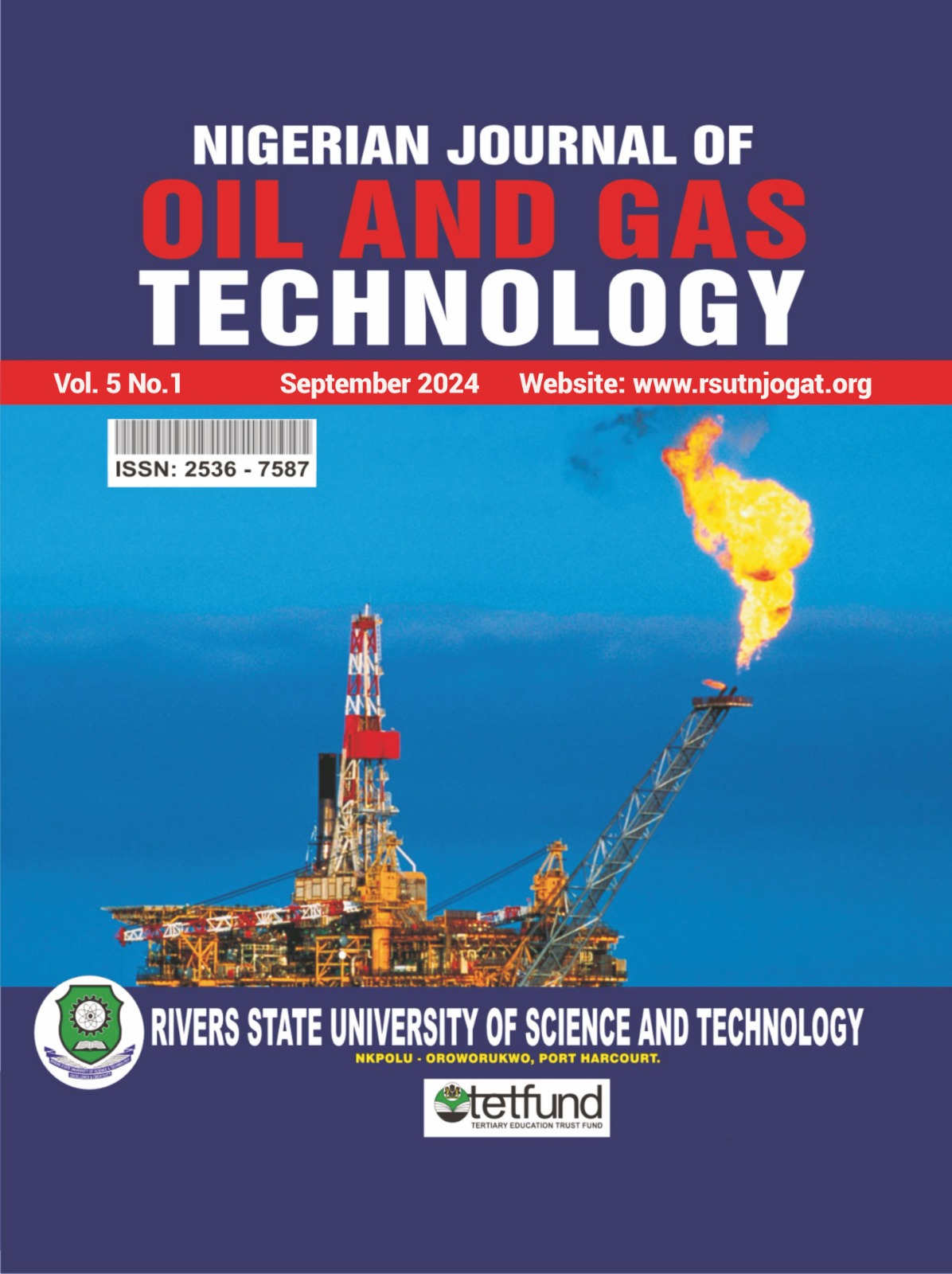
Crude oil biodegradation by two species of Bacillus isolated from Ogbainbiri Oilfield at Apoi Creek, Bayelsa State, Nigeria
Abstract
Nigeria is a major producer and exporter of crude oil. But the sector is challenged by illegal bunkering, sabotage and artisanal refining activities, which has become the leading cause of oil spill. In this study, two bacterial species, Bacillus macauensis (recently renamed Fictibacillus macauensis) and Bacillus altitudinis that was isolated from an illegal bunkering induced oil spill site along a pipeline route at Ogbainbiri Oilfield in Apoi Creek, were used to carry out laboratory biodegradation study of Brass Blend crude oil in shake flask. It was observed that the population of the bacteria species increased over time, which coincided with decrease in ETPH (Extractable Total Petroleum Hydrocarbon) concentration. Over the 35-day experimental period, the percentage degradation of the crude oil was 88.5%, 83.04% and 92.75% for Bacillus macauensis, Bacillus altitudinis and their mixed culture compared to the uninoculated control, which was 0.08%. The enhanced degradation by the mixed culture indicated a synergistic effect. It can therefore be concluded that these bacteria species can be deployed for the bioremediation of oil spill sites at Apoi Creek and environs
Downloads
Riferimenti bibliografici
Adishi, E., & Hunga, M. O. (2017). Oil theft, illegal bunkering and pipeline vandalism: Its impact on Nigeria economy, 2015–2016. International Journal of Economics and Business Management, 3(2), 47–65. http://large.stanford.edu/courses
Al-Hawash, A. B., Alkooranee, J. T., Abbood, H. A., Zhang, J., Sun, J., Zhang, X., & Ma, F. (2018). Isolation and characterization of two crude oil-degrading fungi strains from Rumaila oil field, Iraq. Biotechnology Reports, 17, 104–109.
Al-Otibi, F., Al-Zahrani, R. M., & Marraiki, N. (2022). The crude oil biodegradation activity of Candida strains isolated from oil-reservoirs soils in Saudi Arabia. Scientific Reports, 12, 10708. https://doi.org/10.1038/s41598-022-14836-0
Chikere, C. B., Tekere, M., & Adeleke, R. (2020). Metagenomics insight into microbial dynamics in field-scale remediation of crude oil-polluted soil. Research Square, 1–23. https://doi.org/10.21203/rs.2.20924/v1
Chuah, L. F., Nawaz, A., Dailin, D. J., Oloruntobi, O., Habila, M. A., Tong, W. Y., & Misson, M. (2023). Investigating the crude oil biodegradation performance in bioreactor by using a consortium of symbiotic bacteria. Chemosphere, 337, 139293. https://doi.org/10.1016/j.chemosphere.2023.139293
Denmodei, E. C., & Ohimain, E. I. (2024). Bacterial and physicochemical properties of a crude oil polluted freshwater wetland at Apoi Creek, Bayelsa State, Nigeria. Academia Molecular Biology and Genomics. (In press).
Greenberg, A. E., Clesceri, L. S., & Eaton, A. D. (1992). Standard methods for the examination of water and wastewater (18th ed.). American Public Health Association, American Water Works Association, & Water Environment Federation.
John, R. C., & Okpokwasili, G. C. (2012). Crude oil-degradation and plasmid profile of nitrifying bacteria isolated from oil-impacted mangrove sediment in the Niger Delta of Nigeria. Bulletin of Environmental Contamination and Toxicology, 88(6), 1020–1026. https://doi.org/10.1007/s00128-012-0609-8
Li, J. Y., Liu, Y. F., Zhou, L., Gang, H. Z., Liu, J. F., Sun, G. Z., … Mu, B. Z. (2023). A new biosurfactant-producing strain, Fictibacillus nanhaiensis ME46, isolated from an oil field in China. Environmental Technology, 45(20), 4089–4095. https://doi.org/10.1080/09593330.2023.2240947
Luke, M. E., Odokuma, L. O., & Ogugbue, C. J. (2021). Microbial dynamics and physico-chemical properties of artisanal refinery polluted environment in Niger Delta. GSC Biological and Pharmaceutical Sciences, 15(3), 1–15. https://doi.org/10.30574/gscbps.2021.15.3.0142
Luo, Z., Ma, J., Huang, L., Li, D., Gao, G., Zhao, Y., Antunes, A., & Li, M. (2024). Biodegradation of crude oil and aniline by heavy metal-tolerant strain Rhodococcus sp. DH-2. Microorganisms, 12(11), 2293. https://doi.org/10.3390/microorganisms12112293
Oando Energy Resources. (2024). OML63. https://www.oandoenergyresources.com/projects/oml-63
Obire, O. M. O. K. A. R. O. (1990). Bacterial degradation of three different crude oils in Nigeria. Nigerian Journal of Botany, 3(13), 93–103.
Ogoro, M., Onyeanusi, O. D., & Eze, A. U. (2020). Illegal oil bunkering hotspots, its implication on vegetal depletion in Delta State, Nigeria. Asian Journal of Advanced Research and Reports, 13(3), 50–64. https://doi.org/10.9734/ajarr/2020/v13i330311
Ohimain, E. I. (2022). Benefits and threats of biodiversity conservation in Stubbs Creek Forest Reserve, Nigeria. In Biodiversity in Africa: Potentials, Threats and Conservation (pp. 109–142). Springer Nature Singapore. https://doi.org/10.1007/978-981-19-3326-4_5
Olawepo, G., Ogunkunle, C., Adebisi, O., & Fatoba, P. (2018). Enhanced bioremediation of brass crude-oil (hydrocarbon), using cow dung and implication on microbial population. Pollution, 4(2), 273–280. https://doi.org/10.22059/poll.2017.240833.313
Ozogu, N. A., Olabimtan, O. H., Chukwurah, N. C., Ukpong, M. K., & Daniel, D. S. (2023). Effects and causes of illegal crude oil bunkering in Nigeria: Case study Niger Delta. American Journal of IR 4.0 and Beyond, 2(1), 6–14. https://doi.org/10.54536/ajirb.v2i1.1450
Pepper, I. L., & Gerba, C. P. (2005). Environmental microbiology: A laboratory manual (2nd ed.). Elsevier Academic Press.
Sarwar, A., Brader, G., Corretto, E., Aleti, G., Ullah, M. A., Sessitsch, A., & Hafeez, F. Y. (2018). Qualitative analysis of biosurfactants from Bacillus species exhibiting antifungal activity. PLOS ONE, 13(6), e0198107. https://doi.org/10.1371/journal.pone.0198107
Shaimerdenova, U., Kaiyrmanova, G., Lewandowska, W., Bartoszewicz, M., Swiecicka, I., & Yernazarova, A. (2024). Biosurfactant and biopolymer producing microorganisms from West Kazakhstan oilfield. Scientific Reports, 14, 2294. https://doi.org/10.1038/s41598-024-52906-7
Titah, H. S., Pratikno, H., Purwanti, I. F., & Wardhani, W. K. (2021). Biodegradation of crude oil spill using Bacillus subtilis and Pseudomonas putida in sequencing method. Journal of Ecological Engineering, 22(11), 157–167. https://doi.org/10.12911/22998993/142913
Turner, R. E., & Ohimain, E. I. (2024). Dredged canals, wetland loss, and legacy. Estuaries and Coasts, 47, 2147–2159. https://doi.org/10.1007/s12237-024-01427-7
Umeaku, C. N., Emmy-Egbe, I. O., Ukoha, C. C., Ezenwa, S. E., & Chris-Umeaku, C. I. (2019). Biodegradation of crude oil-polluted soil by bacterial isolates from Nigeria. Frontiers in Environmental Microbiology, 5(1), 14–28. https://doi.org/10.11648/j.fem.20190501.13
Wu, B., Xiu, J., Yu, L., Huang, L., Yi, L., & Ma, Y. (2023). Degradation of crude oil in a co-culture system of Bacillus subtilis and Pseudomonas aeruginosa. Frontiers in Microbiology, 14, 1132831. https://doi.org/10.3389/fmicb.2023.1132831
Wu, B., Xiu, J., Yu, L., et al. (2022). Biosurfactant production by Bacillus subtilis SL and its potential for enhanced oil recovery in low permeability reservoirs. Scientific Reports, 12, 7785. https://doi.org/10.1038/s41598-022-12025-7
Zhang, J., Feng, W., & Xue, Q.(2022). Biosurfactant production and oil degradation by Bacillus siamensis and its potential applications in enhanced heavy oil recovery. International Biodeterioration & Biodegradation, 169, 105388. https://doi.org/10.1016/j.ibiod.2022.105388
Zhang, T., Fan, X., Hanada, S., Kamagata, Y., & Fang, H. H. P. (2006). Bacillus macauensis sp. nov., a long-chain bacterium isolated from a drinking water supply. International Journal of Systematic and Evolutionary Microbiology, 56(Pt 2), 349–353. https://doi.org/10.1099/ijs.0.63868-0