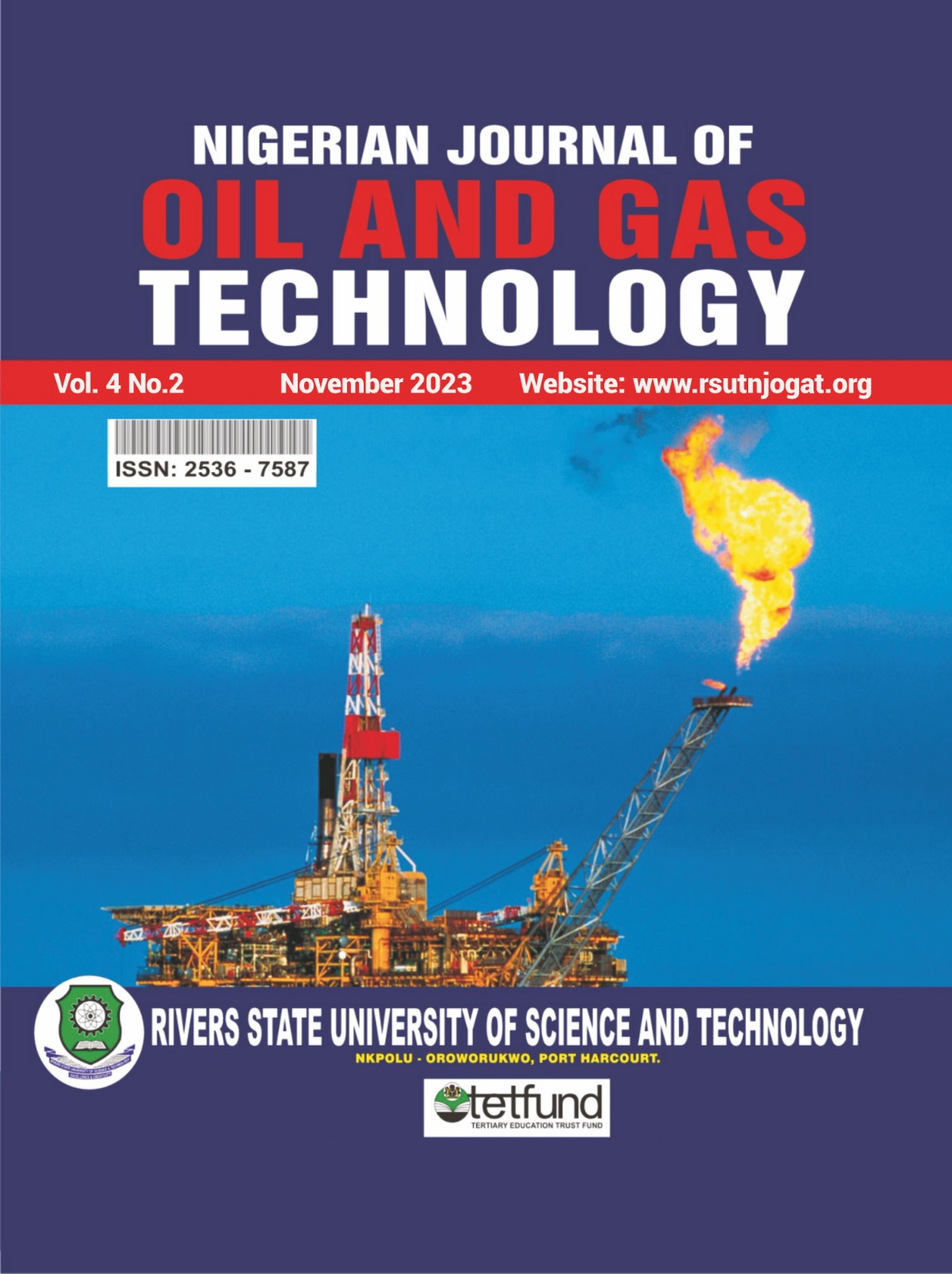
Site Characterization for Foundation Design in Yenagoa, Nigeria
Abstract
Site investigation is performed at a proposed site location in Yenagoa, Nigeria, to establish the soil profile and determine the engineering geological properties of subsoils in the area. The general profile of the soils at the site consists of medium dense 0.95m to 1.95m thick uniformly graded sand (fill) overlying soft to firm greyish brown sandy clay that extended to depths between 3.75m and 6.90m below ground surface. Assessment of the engineering properties of the soils showed that the top sand layers occupying the entire site are medium dense in compact state and are expected to exhibit dilative behaviour when sheared. Again, the sand deposits found at deeper depths are mostly dense with high shearing resistance. The groundwater depth was measured at depths between 0.98m and 1.0m. The percentage of sand in the clay were found to be quite significant (about clay 11% to 22%). The overconsolidation ratio (OCR) of the soils indicated that are mostly normally consolidated. Also, the material can be classified as highly compressible based on the values of coefficient of volume compressibility which was found to range between 0.06MN/m2 and 0.93MN/m2. The values of the coefficient of consolidation which varied between 1.1m2 /yr and 22.3m2 /yr for the applied range of pressures indicates that the clayey soils occupying the site are susceptible to prolonged consolidation. The range of values obtained as maximum dry density (MDD) was between 1.66Mg/m3 and 1.71Mg/m3 while the optimum moisture content ranged between 12.4% and 15.9%. The second geoelectric layer has the lowest resistivity value among the three geoelectric layers and occur in the depth range of about 1.47m to 31m. The second layer (depth range of 1.47m to 31m) whose resistivity value range is 23-75Ωm is in the range of highly corrosive to moderately corrosive severity rating. The bearing resistance values for shallow foundation are relatively high at about 122kPa, 141kPa, 160kPa and 198kPa respectively for a 1.0m, 1.5m, 2.0m and 3.0m footing size. This is attributed to the shearing resistance values obtained for the sand. The result showed that foundation pressure in the order of 120kPa and placed at 0.5m depth would cause tolerable settlement for footing width not exceeding 1.0m. Also, the medium to dense sand layers encountered from depth of 10m and beyond is recommended as the points of pile termination. The working loads obtainable for 406mm, 600mm, and 800mm diameter pile at 12m depths is 299kN, 620kN, and 1072kN for the referenced borehole point. The study showed that within the sand layers the magnitude of the vertical downward movement experienced by the piles are small. Also, the settlement is less than 10% of the pile diameter under higher load magnitudes. It showed that the bearing resistance of the piles can be adopted as the allowable values. It is envisaged that this work will provide reliable information for foundation design problem in the region.
Downloads
Riferimenti bibliografici
Abija, F., Teme, S., & Oborie, E. (2018). Geotechnical considerations for the design and construction of foundation in a marshy stream channel of Iwochang-Ibeno, Eastern Niger Delta, Nigeria. Journal of Civil, Construction and Environmental Engineering, 154–170.
ACI 318. (2014). Building code requirements for structural concrete. American Concrete Institute.
AA500. (n.d.). Atomic absorption spectrometer - PG Instruments.
Alabi, A. (2021). Site characterization for engineering purposes using geophysical and geotechnical techniques. Materials and Geoenvironment.
Allen, J. (1965). Late Quaternary Niger Delta and adjacent area; Sedimentary environment and lithofacies. American Association of Petroleum Geologists Bulletin, 547–600.
Amadi, A., Eze, C., Igwe, C., Okunlola, I., & Okoye, N. (2012). Architect’s and geologist’s view on the causes of building failures in Nigeria. Modern Applied Science, 31–38.
APHA. (1992). Chloride by argentometric method (4500-Cl-B). In Standard methods for the examination of water and wastewater. American Public Health Association.
APHA. (1992). Flame atomic absorption spectroscopy (Method 3111B). In Standard methods for the examination of water and wastewater. American Public Health Association.
APHA. (1992). Sulfate by buffer solution (4500-SO₄²⁻-E). In Standard methods for the examination of water and wastewater. American Public Health Association.
APHA. (2018). Hydrogen ion activity (4500-H⁺B). In Standard methods for the examination of water and wastewater. APHA Press.
Asseez, L. (1989). Review of the stratigraphy, sedimentation and structure of the Niger Delta. In C. Kogbe (Ed.), Geology of Nigeria (pp. 311–324). Rockview Nigeria Limited.
Bowles, J. E. (1997). Foundation analysis and design (5th ed.). McGraw-Hill.
British Standards Institution. (1990). BS 1377-1:1990. Methods of test for soils for civil engineering purposes – Part 1: General requirements and sample preparation.
British Standards Institution. (1990). BS 1377-2:1990. Methods of test for soils for civil engineering purposes – Part 2: Classification tests.
British Standards Institution. (1990). BS 1377-4:1990. Methods of test for soils for civil engineering purposes – Part 4: Compaction-related tests.
British Standards Institution. (2015). BS 5930:2015. Code of practice for site investigations.
British Standards Institution. (2007). BS EN 1997-2:2007. Eurocode 7 – Geotechnical design – Part 2: Ground investigation and testing.
British Standards Institution. (2004). EN 1997-1:2004. Eurocode 7 – Geotechnical design – Part 1: General rules.
Hettiarachchi, H., & Brown, T. (2009). Use of SPT blow counts to estimate shear strength properties of soils: Energy balance approach. Journal of Geotechnical and Geoenvironmental Engineering, 135(6).
International Organization for Standardization (ISO). (2005). EN ISO 22476-3:2005. Geotechnical investigation and testing – Field testing – Part 3: Standard penetration test.
International Organization for Standardization (ISO). (2006). ISO 22475-1:2006. Geotechnical investigation and testing – Sampling methods and groundwater measurements – Part 1: Technical principles for execution.
International Organization for Standardization (ISO). (2012). EN ISO 22476-1:2012. Geotechnical investigation and testing – Field testing – Part 1: Electrical cone and piezocone penetration test.
International Organization for Standardization (ISO). (2014). EN ISO 17892-2:2014. Geotechnical investigation and testing – Laboratory testing of soil – Part 2: Determination of bulk density.
International Organization for Standardization (ISO). (2015). EN ISO 17892-3:2015. Geotechnical investigation and testing – Laboratory testing of soil – Part 3: Determination of particle density.
International Organization for Standardization (ISO). (2016). EN ISO 17892-4:2016. Geotechnical investigation and testing – Laboratory testing of soil – Part 4: Determination of particle size distribution.
International Organization for Standardization (ISO). (2017). EN ISO 17892-5:2017. Geotechnical investigation and testing – Laboratory testing of soil – Part 5: Incremental loading oedometer test.
International Organization for Standardization (ISO). (2018). EN ISO 14688-2:2018. Geotechnical investigation and testing – Identification and classification of soil – Part 2: Principles for classification.
International Organization for Standardization (ISO). (2018). EN ISO 17892-8:2018. Geotechnical investigation and testing – Laboratory testing of soil – Part 8: Unconsolidated undrained triaxial test.
International Organization for Standardization (ISO). (2018). EN ISO 17892-10:2018. Geotechnical investigation and testing – Laboratory testing of soil – Part 10: Direct shear tests.
International Organization for Standardization (ISO). (2018). EN ISO 17892-12:2018. Geotechnical investigation and testing – Laboratory testing of soil – Part 12: Determination of liquid and plastic limits.
Mayne, P., Christopher, B., Berg, R., & DeJong, J. (2002). Subsurface investigations – Geotechnical site characterization. National Highway Institute, Federal Highway Administration. (FHWA-NHI-01-031).
NAVFAC. (1986). Soil mechanics – Design manual 7.01 (NAVFAC-DM7-1). Naval Facilities Engineering Command.
Oladunjoye, M., Salami, A., Aizebeokhai, A., Sanuade, O., & Kaka, S. (2017). Preliminary geo-technical characterization of a site in Southwest Nigeria using integrated electrical and seismic methods. Journal of the Geological Society of India, 86(2), 209–215.
Onyeagucha, A. (1980). Petrography and depositional environment of the Benin Formation. Journal of Mining and Geology, 47–51.
Oyeyemi, K., Olofinnade, O., Aizebeokhai, A., Sanuade, O., Oladunjoye, M., Ede, A., … Ayara, W. (2020). Geoengineering site characterization for foundation integrity assessment. Cogent Engineering, 7(1).
Schneider, H. (1999). Panel discussion: Definition and determination of characteristic soil properties. In 14th International Conference on Soil Mechanics and Foundation Engineering, Hamburg.
Short, K., & Stauble, A. (1967). Outline of the geology of Niger Delta. American Association of Petroleum Geologists Bulletin, 761–779.
Teme, S. (2002). Geotechnical considerations on foundation design in the Niger Delta. Nigerian Mining and Geosciences Society, 51.
Wolff, T. (1989). Pile capacity prediction using parameter functions. ASCE Geotechnical Special Publication, 23, 96–107.