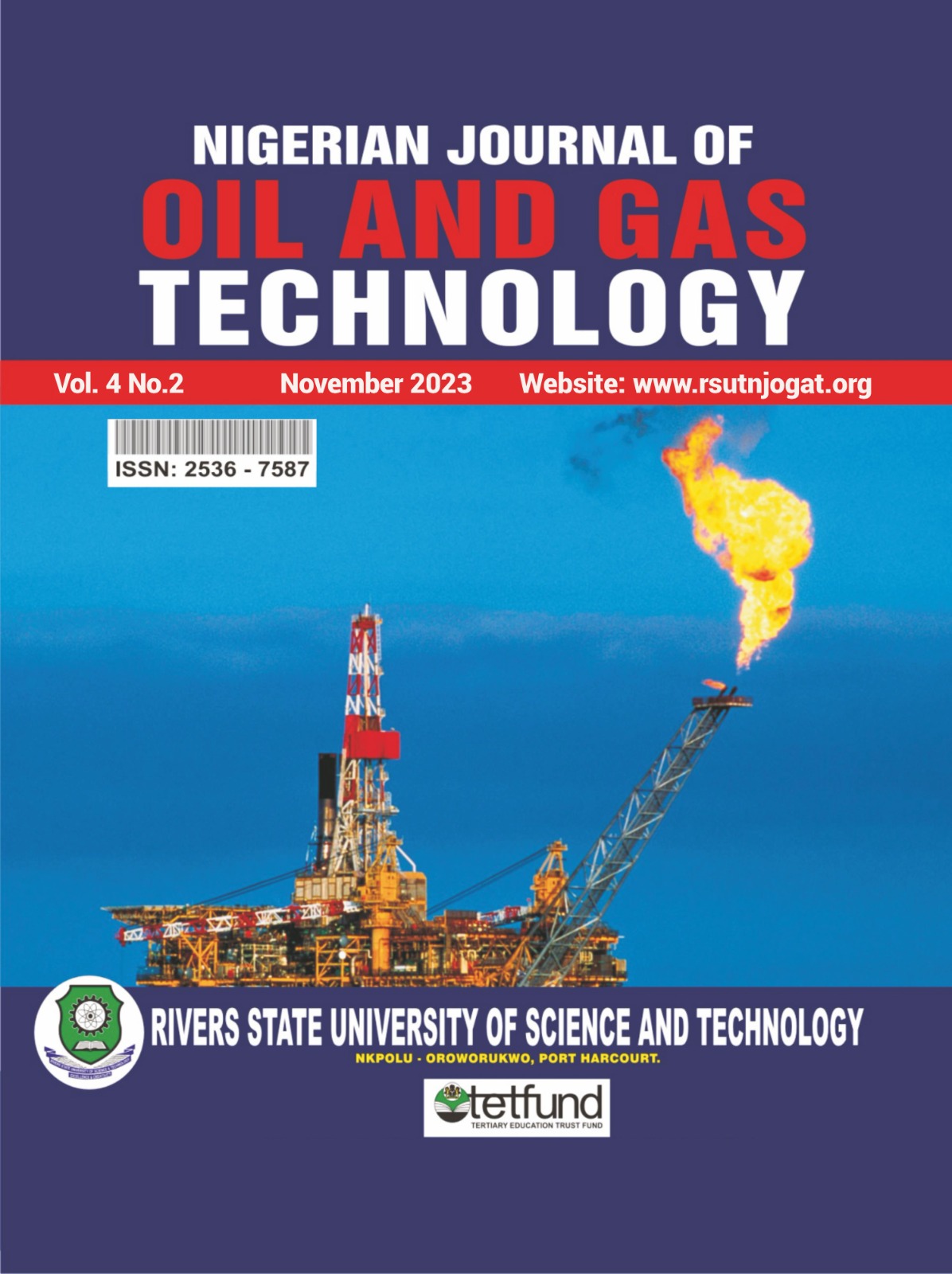
Non-Cancer Human Health Risk Assessment of Heavy Metals in Black Carbon Monitored in Port Harcourt, Rivers State, Nigeria
Resumen
Due to the continuous presence of black carbon (soot) in the lower atmosphere of Port Harcourt and its environs; heavy metals, contained in the soot, are released into the environment with potential for absorption into systemic circulation through inhalation, ingestion and dermal contact. About forty samples were assessed and collected, in the dry and wet seasons, from different selected locations in the metropolis and their heavy metals concentration determined using atomic absorption spectrophotometer (AAS). Non-cancer health risk was assessed, using United State Environmental Protection Agency (USEPA) guidelines, to evaluate the hazard quotient (HQ) and the hazard index (HI) following exposure. The results showed that the mean concentration of Cd, Cr, Co, Pb and Ni in dry season are 0.39 mg/kg, 6.60 mg/kg, 1.61 mg/kg, 4.38 mg/kg and 1.03 mg/kg respectively and the mean concentrations of Cd, Co, Pb and Ni in wet season are 0.14 mg/kg, 0.11 mg/kg, 0.27 mg/kg and 0.19 mg/kg respectively. Concentration of Cr was below detectable level in the rainy season. The HQ and HI of these heavy metals were calculated for ingestion, dermal contact and inhalation exposure pathways and values obtained for dry season were higher than those obtained for wet season. All values of HQ and HI obtained in both dry and wet seasons for adults were lower than the USEPA guideline value of 1, showing that there is relatively low non-cancer health risk posed by the identified heavy metals in the soot. However, in the dry season only, dermal HQ for Co was 1.77 and HI value for all the five metals was 2.19, thus making the children resident vulnerable to lung and heart diseases as well as disease conditions such as allergic reactions, effect on developing fetus due to intake of cobalt. The HI values for children in both seasons were higher than that of adult in the study area. While HI of children is approximately 3 times that of adult in dry season, it is approximately double that of adults in the wet season. This implies that children are more susceptible and at greater non-cancer health risk of exposure to soot derived heavy metals than adults in Port Harcourt. There is need for effective measure to reduce the release of cobalt and other four metals due to their high HI of 2.19 in the environment to avert the potential noncancer health risk of not only Co but all the five metals. This risk assessment study can be used in health based risk communication to address the impact of heavy metals in soot continuously present in the lower atmosphere of Port Harcourt and its environs.
Descargas
Referencias
Adeyemi, O., Oloyede, O. B., & Oladiji, A. T. (2007). Physicochemical and microbial characteristics of leachate-contaminated groundwater. Asian Journal of Biochemistry, 2, 343–348. https://doi.org/10.3923/ajb.2007.343.348
Ayantobo, O. O., Awomeso, J. A., Oluwasanya, G. O., Bada, B. S., & Taiwo, A. M. (2014). Non-cancer human health risk assessment from exposure to heavy metals in surface and groundwater in Igun Ijesha, Southwest Nigeria. American Journal of Environmental Sciences, 10(3), 301–311. http://www.thescipub.com/ajes.toc
Celo, V., & Dabek-Zlotorzynska. (2010). Concentration of and source origin of trace metals in PM2.5 collected at selected Canadian sites within the Canadian Air Pollution Surveillance Program. In Zereini, F., & Wiseman, C. L. S. (Eds.), Urban particulate matter: Origin, chemistry, fate and health impacts (pp. xx–xx). Springer.
Department of Petroleum Resources (DPR). (1991). Environmental guidelines and standards for the petroleum industry in Nigeria. Ministry of Petroleum Resources, Lagos, Nigeria.
Du, Y., Gao, B., Zhou, H., Ju, X., Hao, H., & Yin, S. (2013). Health risk assessment of heavy metals in road dusts in urban parks of Beijing, China. International Symposium on Environmental Science and Technology (ISEST).
Durowoju, O. S., Edokpayi, J. N., Popoola, O. E., & Odiyo, J. O. (2018). Health risk assessment of heavy metals on primary school learners from dust and soil within school premises in Lagos State, Nigeria. https://doi.org/10.5772/intechopen.74741
Ede, P. N., Ubong, I. U., & Osuagwu, O. N. (2018). Lichen as indicator for air pollution in Port Harcourt City. Journal of Geosciences and Environmental Research, 1(1), 69–74.
Federal Environmental Protection Agency (FEPA). (1991). Guideline and standard for environmental pollution control in Nigeria. Federal Republic of Nigeria.
Gobo, A. E., & Abam, T. K. S. (2006). Return period analysis as a tool for urban flood prediction in the Niger Delta: A case study of Port Harcourt City, Nigeria. Journal of Environmental Hydrology, 14. http://www.hydroweb.com
Kamunda, C., Mathuthu, M., & Madhuku, M. (2016). Health risk assessment of heavy metals in soils from Witwatersrand gold mining basin, South Africa. International Journal of Environmental Research and Public Health. https://www.mdpi.com/journal/ijerph
Kosiorek, M., & Wyszkowski, M. (2019). Effect of cobalt on environment and living organisms – A review. Applied Ecology and Environmental Research, 17(5), 11419–11449.
Lu, X., Wang, L., Li, L., Lei, Y. K., Huang, L., & Kang, D. (2010). Multivariate statistical analysis of heavy metals in street dust of Baoji, NW China. Journal of Hazardous Materials, 173, 744–749.
Miguel, E., De Llamas, J. F., Chacon, E., & Mazadiego, L. F. (1999). Sources and pathways of trace elements in urban environments: A multielemental qualitative approach. Science of the Total Environment, 235, 355–357.
U.S. Environmental Protection Agency (USEPA). (1989a). Risk assessment guidance for superfund, Volume 1: Human health evaluation manual (EPA/540/189/002). Office of Solid Waste and Emergency Response.
U.S. Environmental Protection Agency (USEPA). (1989b). Risk assessment guidance for superfund, Volume 1 (Part A): Human health evaluation manual. Office of Emergency and Remedial Response.
U.S. Environmental Protection Agency (USEPA). (1991). Risk assessment guidance for superfund Volume 1: Human health evaluation manual supplemental guidance – Standard default exposure factors (OSWER Directive 9285.6-03).
U.S. Environmental Protection Agency (USEPA). (2007). Dermal exposure assessment: A summary of EPA approaches (EPA/600/R-07/040F). National Center for Environmental Assessment. http://www.epa.gov/ncea
U.S. Environmental Protection Agency (USEPA). (2012). Edition of the drinking water standards and health advisories (EPA 822S-12-001). Office of Water.
U.S. Environmental Protection Agency (USEPA). (2017). Health and environmental effects of particulate matter (PM). EPA Web Archive. https://www.epa.gov/pm-pollution/healthandenvironmental-effects-particulate-matter-pm
World Health Organization/World Meteorological Organization (WHO/WMO). (1971). Air monitoring programme designed for urban and industrial area. UNEP, Geneva.
Yakubu, O. H. (2017). Particle (soot) pollution in Port Harcourt Rivers State, Nigeria — Double air pollution burden? Understanding and tackling potential environmental public health impacts. Environments, MDPI. https://www.mdpi.com
Yongming, H., Peixuan, D., Junji, C., & Posmentier, E. S. (2005). Multivariate analysis of heavy metal contamination in urban dusts of Xi’an, Central China. Science of the Total Environment, 355, 176–186. https://doi.org/10.1016/j.scitotenv.2005.02.026