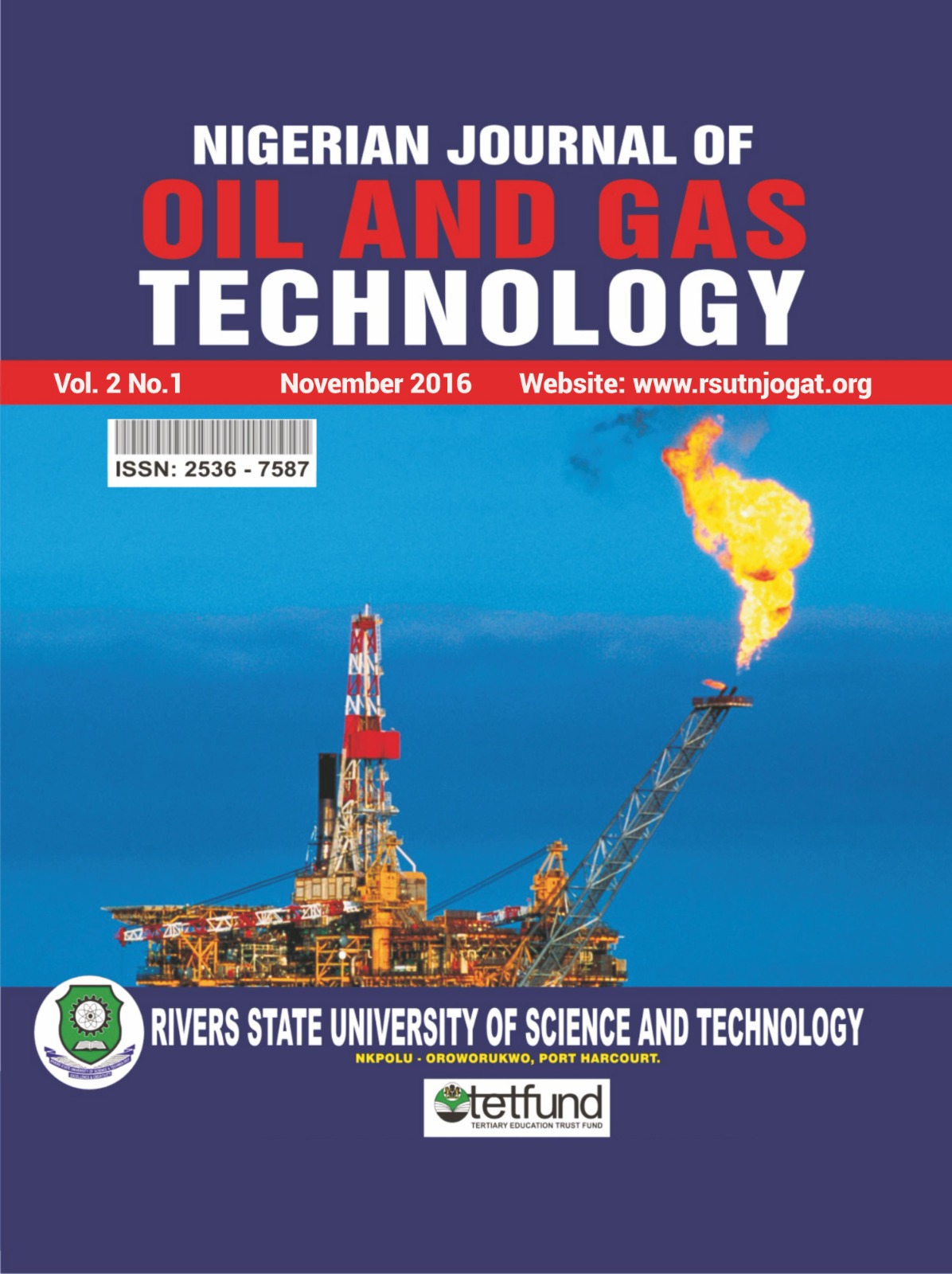
Overview on the Emergence of Marginal Oil Fields in Nigeria and Their Contribution to the Country's Oil Production
Abstract
The Federal Government of Nigeria initiated the development program of the Marginal Oil Field to increase production, reserves, employment, and indigenous participation in oil and gas business. Between 2000 and 2010, 30 marginal fields were farmed out to indigenous oil companies by the multinational oil companies. As at 2016, only 10 of the fields have been put into production. The marginal fields began production in 2005 with an output of 141,028 barrels which represented less than 0.02% of the country's production. This increased to 0.09% in2006. In 2007,the production significantly dropped to 0.054%. In the following years, there was increase in the number of producing companies with a corresponding increase in production. By 2014, nine marginal field operators were contributing about 2.46% of Nigeria total oil production. More than 66% of the marginal fields have not started production more than 10 years after the fields were acquired.
Downloads
References
Aalund, L. R. (1996). Oil companies focus on emergency care for expats in Russia. Oil and Gas Journal, 94(18), 33–36.
Department of Petroleum Resources – DPR. (2013). Guidelines for the farm-out and operations of marginal fields (28 pages).
Department of Petroleum Resources. (2016). Concessions and leases report (12 pages).
Frank, A. (2010). Offshore oil drilling and hurricane risks: Triple crisis (1 page).
Heimer, J. A., Bryan, L. A., & Weeks, J. D. (1978). Logistics problems in developing remote oil fields – A case history from Prudhoe Bay. Journal of Petroleum Technology, 30(6), 851–859.
Ivanhoe, L. F., & George, G. L. (1993). Global oil, gas fields, sizes tallied, analyzed. GeoArabia, 91(7), 87–91.
McDonald, J. (1992). Hurricanes Andrew and Iniki 1992: Environmental quality engineering international summary report (3 pages).
Mieras, A. A. (1984). Operational performance of the Buchan field floating production and offshore loading system. In Proceedings of Southeast Asia Show (pp. xx-xx). Singapore: Society of Petroleum Engineers Publishers.
Nigerian National Petroleum Corporation. (2012). Annual statistical bulletin (72 pages).
Nigerian National Petroleum Corporation. (2014). Annual statistical bulletin (52 pages).
Njoku, A. O. (2016). Oil pipelines vandalism and its effects on the socio-economic development in Nigerian society. International Journal of Multidisciplinary Academic Research, 4(4), 47–60.
Peter, R. O. (2013). Oil and gas: Global issues. Multi-Science Publishing (72 pages).
Robinne, F. N., Parisien, M. A., & Flannigan, M. D. (2016). Anthropogenic influence on wildfire activity in Alberta, Canada. International Journal of Wildland Fire, 25(9), 911–916.
Shrimpton, M., & Storey, K. (1996). Health and safety issues related to remote operations. In Proceedings of Third International Conference on Health, Safety, & Environment (pp. xx-xx). New Orleans: Society of Petroleum Engineers Publishers.
Simmons, T. M., Sutter, D., & Pielke, R. (2013). Normalize tornado damage in the United States. Environmental Hazards, 12(2), 132–147.