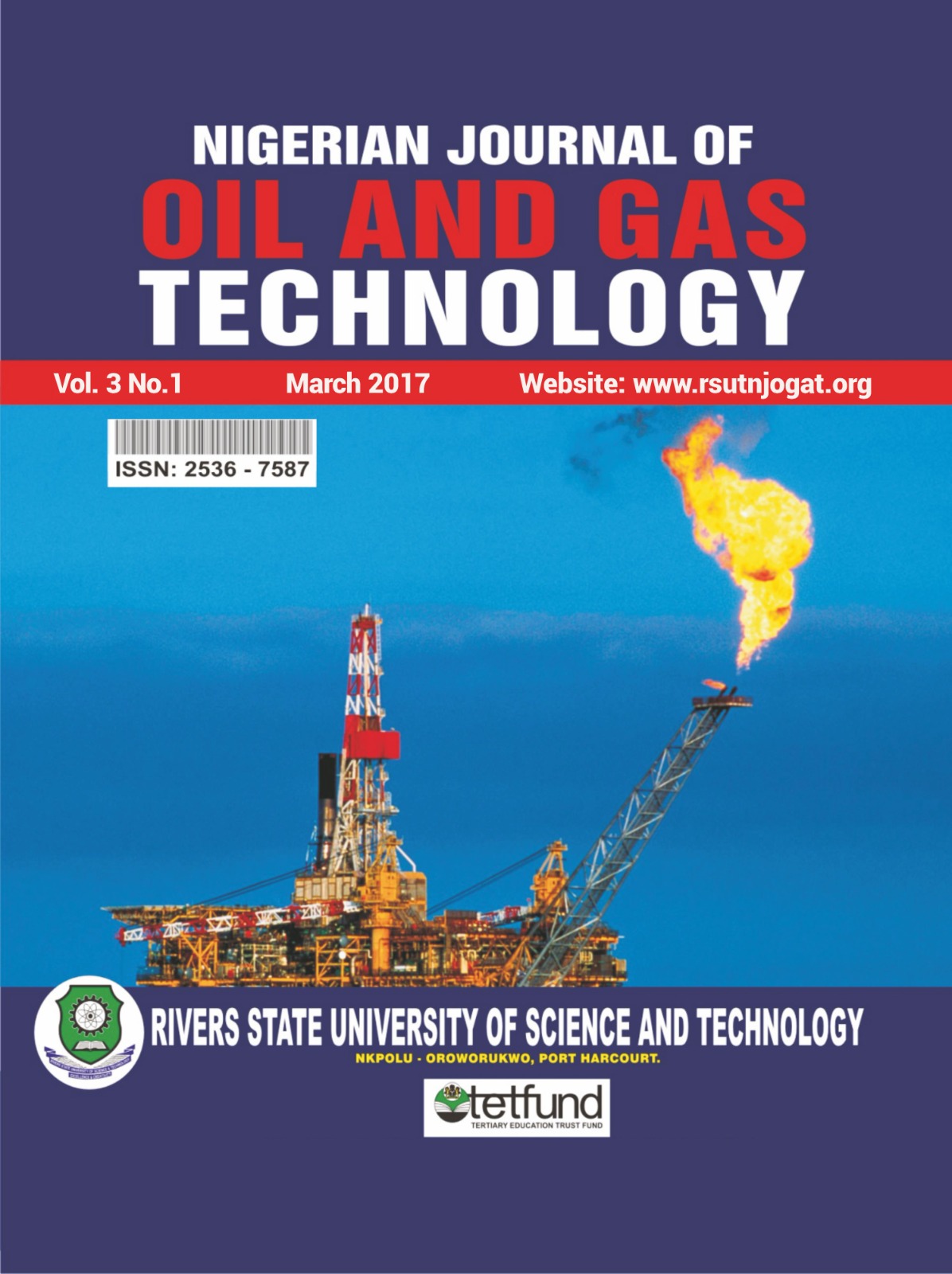
Air Quality Assessment Around Selected Gas Flare Sites in Rivers State, Nigeria
Abstract
The quality of air around some gas flare sites in Rivers State of Nigeria was determined by measuring major air pollutants at different distances from the area. Programmable Multi Gas Monitors, Gas Detection Tubes, Aerosol Mass Monitor, Digital Anemometer and Compass were used. The results showed that the mean levels of pollutants ranged from 155.7±78.3 µg/m3 (Oshie) – 166.1±90.3 µg/m3 (Rumuekpe) TSP, 0.1- 0.15±0.07ppm (Obagi) NO2,
0.1-0.2±0.14ppm (Obagi) SO2, <0.2ppm H2S, <0.1 (Idu and Rumuekpe) -0.2±0.14ppm (Obagi) CO, <0.10.45±0.49ppm (Obagi) VOC and <0.5ppm C6H6 . The highest concentrations of some pollutants such as TSP, NO2, SO2, H2S and C6H6 exceeded Federal Ministry of Environment and United State EPA permissible limits. It was concluded that the quality of air around the flare sites is poor and gas flaring contributed to the levels of pollutants measured. Thus there is need for regular monitoring.
Downloads
Literaturhinweise
Ashton, N. J., Arnott, S., & Douglas, O. (1999). The human ecosystems of the Niger Delta – an ERA handbook. Environment Rights Action. Lagos. 224 pp.
FMENV (Federal Ministry of Environment). (1991). National Guidelines and Standards for Industrial Effluents, Gaseous Emissions and Hazardous Wastes Management in Nigeria. FEPA, Lagos, pp. 59–66.
Global Gas Flaring Reduction Initiative (GGFRI). (2002). Report on consultations with stakeholders. World Bank Group in collaboration with the Government of Norway. Retrieved February 11, 2005, from http://www.worldbank.org/ogmc/files.global-gas-flaring-initiative.pdf
Ideriah, T. J. K., Braide, S. A., Fekarurhobo, G., & Oruambo, I. (2001). Determination of indoor and outdoor concentrations of suspended particulate matter in South-Eastern Nigeria. Ghana Journal of Science, 41, 23–27.
Kaldany, R. (2001). Global Gas Flaring Reduction Initiative. Oil, Gas and Chemicals, World Bank Group, Marrakesh.
Manby, B. (1999). The price of oil: Corporate responsibility and human rights violation in Nigeria's oil production communities. Human Rights Watch, New York. 202 pp.
O'Rourke, D., & Connolly, S. (2003). Just oil? The distribution of environmental and social impacts of oil production and consumption. Reviews in Advance, 28(05), 1–31.
Smith, E. (1992). United States Environmental Protection Agency. Office of Air Quality Planning and Standards, Research Triangle Park, North Carolina. Private Communications.
Strosher, M. (1996). Investigation of gas flare emission in Alberta. Alberta Research Council, Alberta, Canada.
Umesi, N. O., Ideriah, T. J., & Abah, S. (2009). Background concentration of NO2 prior to construction and operation of a gas-fired power plant in the Niger Delta Region of Nigeria. Environment and Ecology, 27(2), 592–602.
United States Environmental Protection Agency (USEPA). (1990). National Air Quality and Emissions Trends Report, 1998. Technical Division, Office of Air and Radiation, Office of Air Quality Planning and Standards, Research Triangle Park, North Carolina. EPA450/4-90-011.
Watts, M. (2001). Petro-violence: Community, extraction and political ecology of a mythic commodity. In M. Watts & N. Peluso (Eds.), Violent environments (pp. 189–212). Cornell University Press.
World Health Organization (WHO). (2005). Air Quality Guidelines for particulate matter, ozone, nitrogen dioxide and sulphur dioxide: Global update. Summary Risk Assessment (pp. 8–15). Retrieved from http://www.epa.gov/pm-pollution