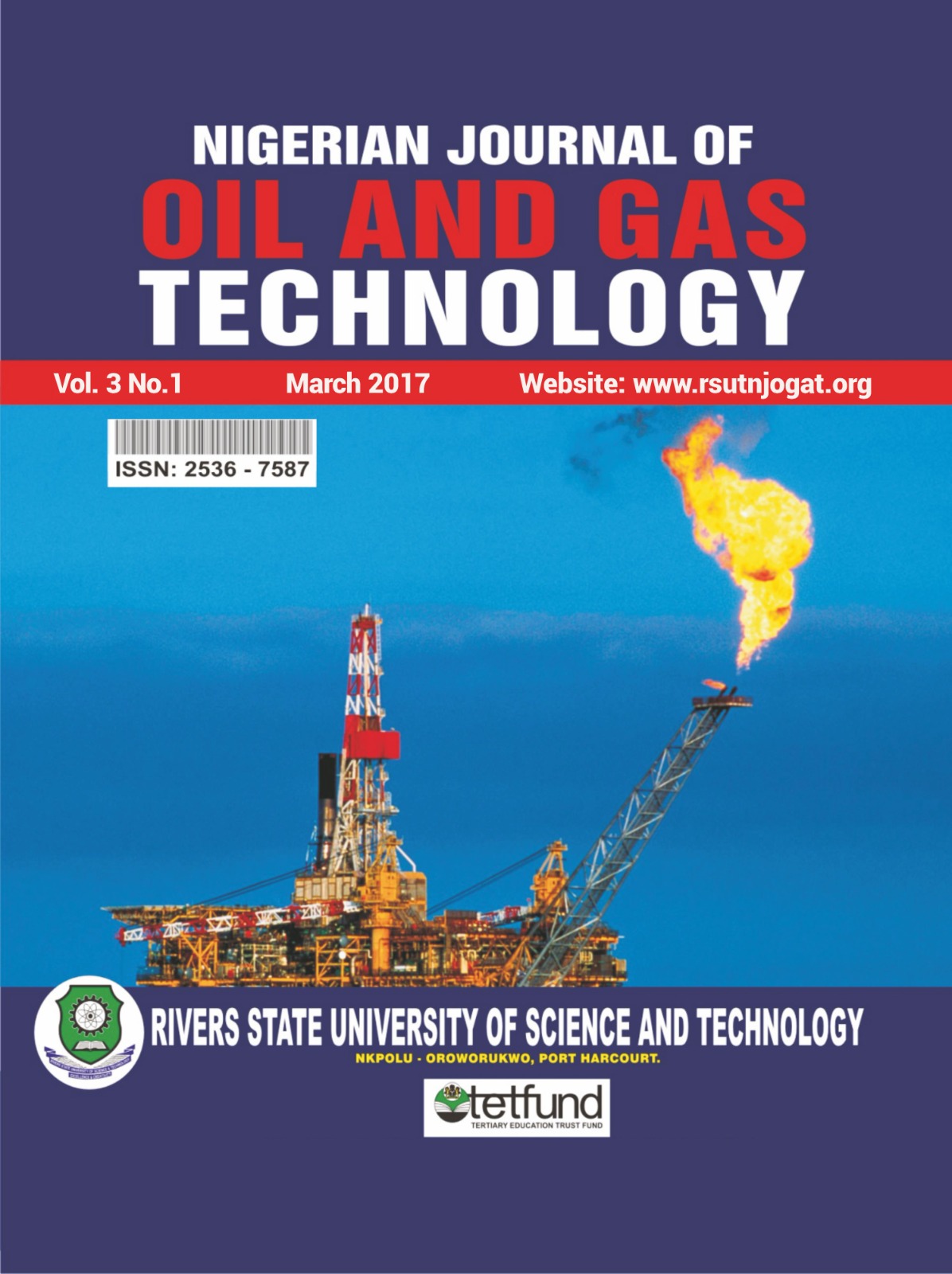
Distribution of Hemoglobin Genotypes Amongst Residents in Port Harcourt
Abstract
A study of the distribution of haemoglobin genoctpes was carried out amongst the Igbos, Yorubas, and Hausas living in Port Harcourt, The study considered 156 adult subjects: 123 males, and 33 females. Electrophoresis was performed using standard methods. The results d s) showed that the mean and standard deviations (:7 of the haemoglobin (Hb) variants were HbAA (37.00=1.732), HbAS (14.67=2.309), and HbAC (0.33=0.058). The distribution of haemoglobin (Hb) among the subjects were HI,A..4 111 (71.15%), HbAS44(28.21%) and HbAC 1 (0.649-6). Among the males, 93(75.6196) were HbAA, 30(24.39%) were HbAS and no males had HbAC. Among the 44 females 18 (54.55%) were H5A-4, 14(42.42%) HbAS; and 1(3.0396) HbAC. The Percentage of patterns with Igbos were (HbAA 36(69.23%) and (HbAS 16(30.7796)), and Hausa were (Hb.A.A 39 (76.47%) and HbAS 12 (23.5396) and Yorubas were aHbA..4 36(67.9496), HbAS 16(30.1996) and HbAC 1 (1.89%)). In this work, the only HbAC encountered was observed among samples from the females. A high prevalence of variants _ACA and AS heamoglobin was observed in the population.
Downloads
Literaturhinweise
Akhigbe, R. E., Ige, S. F., Afolabi, A. O., Azeez, O. M., Adegunlola, G. J., & Bamidele, J. O. (2009). Prevalence of haemoglobin variants, ABO and Rhesus blood groups in Ladoke Akintola University of Technology, Ogbomoso, Nigeria. Trends in Medical Research, 4, 24–29.
Alagbe, E. E., Susu, A. A., & Dosun, A. O. (2013). Sickle cell disease (SCD) management: A theoretical review. International Journal of Research and Applied Sciences (IJRAS), 16(3), 3–15.
Bakare, A. A., Azeez, M. A., & Agbolade, J. O. (2004). Gene frequencies of ABO and Rhesus blood groups and haemoglobin variants in Ogbomosho, South-West Nigeria. Global Journal of Medical Science, 3, 17–22.
Booth, C., Inusa, B., & Obaro, S. R. (2010). Infection in sickle cell disease: A review. International Journal of Infectious Diseases, 14(1), e2–e12.
Cheesbrough, M. (2000). District laboratory practice in tropical countries (Part 2, pp. 283–284). Cambridge: Cambridge University Press.
Conran, N., & Costa, F. F. (2016). Sickle cell anemia: From basic science to clinical practice. Springer.
Creary, M., Williamson, D., & Kulkarni, R. (2007). Sickle cell disease: Current activities, public health implications, and future directions. Journal of Women’s Health, 16, 575–582.
Dominguez, Y., Zurita, C., Calvopina, D., Villacis, J., & Mora, M. (2013). Prevalence of common hemoglobin variants in an Afro-descendent Ecuadorian population. Biomedical Research Notes, 6, 132.
Egesie, U. G., Egesie, O. J., Usar, I., & Johnbull, T. O. (2008). Distribution of ABO, Rhesus blood and haemoglobin electrophoresis among undergraduate students of Niger Delta State University, Nigeria. Nigerian Journal of Physiological Sciences, 23, 5–8.
Erhabor, O., Adias, T. C., Jeremiah, Z. A., & Hart, M. L. (2010). Abnormal hemoglobin variants, ABO, and Rhesus blood group distribution among students in the Niger Delta of Nigeria. Pathology and Laboratory Medicine International, 2, 41–46.
Gladwin, M. T., & Sachdev, V. (2012). Cardiovascular abnormalities in sickle cell disease. Journal of the American College of Cardiology, 6(9 Suppl), S5–S8.
Gulbis, B., Cotton, F., Ferster, A., Ketelslegers, O., Dresse, M. F., Ronge-Collard, E., Minon, J. M., Le, P. Q., & Vertongen, F. (2009). Neonatal haemoglobinopathy screening in Belgium. Journal of Clinical Pathology, 62, 49–52.
Jeremiah, Z. A. (2006). Abnormal haemoglobin variants, ABO and Rh blood groups among students of African descent in Port Harcourt, Nigeria. African Health Sciences, 6, 177–181.
Kumar, V., Abbas, A. K., Fausto, N., & Aster, J. (2009). Robbins and Cotran pathologic basis of disease (Professional Edition). Elsevier Health.
Lane, P. A., & Githens, J. H. (2005). Splenic syndrome at mountain altitudes in sickle cell trait. New England Journal of Medicine, 253, 2251.
Millodot, M. (2009). Dictionary of optometry and visual science (7th ed.). Butterworth-Heinemann.
Modiano, D., Luoni, G., Sirima, B. S., Simpore, J., Verra, F., Konate, A., ... & Coluzzi, M. (2001). Haemoglobin C protects against clinical Plasmodium falciparum malaria. Nature, 414, 305–308.
Moormann, A. M., Embury, P. E., Opondo, J., Sumba, O. P., Ouma, J. H., Kazura, J. W., & John, C. C. (2003). Frequencies of sickle cell trait and glucose-6-phosphate dehydrogenase deficiency differ in highland and nearby lowland malaria-endemic areas of Kenya. Transactions of the Royal Society of Tropical Medicine and Hygiene, 97, 513–514.
Njamnshi, A. K., Mbong, E. N., Wonkam, A., Ongolo-Zogo, P., Djientcheu, V. D., Sunjoh, F. L., ... & Muna, W. F. (2006). The epidemiology of stroke in sickle cell patients in Yaounde, Cameroon. Journal of the Neurological Sciences, 250, 79–84.
Nwafor, A., & Banigo, B. M. (2001). A comparison of measured and predicted hemoglobin genotype in a Nigerian population in Bonny, Rivers State. Journal of Applied Science and Environmental Management, 5, 79–81.
Patel, J., Patel, A., Patel, J., Kaur, A., & Patel, V. (2008). Prevalence of hemoglobinopathies in Gujarat, India: A cross-sectional study. Internet Journal of Hematology, 5(1).
Pierigè, F., Serafini, S., Rossi, L., & Magnani, M. (2008). Cell-based drug delivery. Advanced Drug Delivery Reviews, 60(2), 286–295.
Prabhakar, H., Haywood, C., Jr., & Molokie, R. (2010). Sickle cell disease in the United States: Looking back and forward at 100 years of progress in management and survival. American Journal of Hematology, 85(5), 346–353.
Roberts, D. J., & Williams, T. N. (2003). Haemoglobinopathies and resistance to malaria. Redox Report, 8, 304–310.
Titus, H. J. H., Carver, M. F. H., & Efremov, G. D. (2006). El-Hazmi, M. A. F., & Warsy, A. S. The effects of glucose-6-phosphate dehydrogenase deficiency on haematological parameters and clinical manifestations in patients with sickle cell anaemia. Tropical and Geographical Medicine, 41, 52.
Tshilolo, L., Kafando, E., Sawadogo, M., Cotton, F., Vertongen, F., Ferster, A., & Gulbis, B. (2008). Neonatal screening and clinical care programmes for sickle cell disorders in sub-Saharan Africa: Lessons from pilot studies. Public Health, 122, 933–941.
Verra, F., Bancone, G., Avellino, P., Blot, I., Simpore, J., & Modiano, D. (2007). Haemoglobin C and S in natural selection against Plasmodium falciparum malaria: A plethora or a single shared adaptive mechanism? Parassitologia, 49, 209–213.
Weatherall, D. (2010). The inherited diseases of hemoglobin are an emerging global health burden. Blood, 115, 4331–4336.
Weatherall, D. (2011). The inherited disorders of the hemoglobin: An increasingly neglected global health burden. Indian Journal of Medical Research, 134(4), 493–497.
Williams, T. N. (2012). Balancing act: Haemoglobinopathies and malaria. Lancet Infectious Diseases, 12, 427–428.
World Health Organization. (2006). Sickle-cell anaemia. In Fifty-ninth World Health Assembly, May 22–27; Geneva, Switzerland.