Oil and Gas Exploration, Poverty and Its Consequences on the People of Niger Delta: The Bayelsa State Experience
Abstract
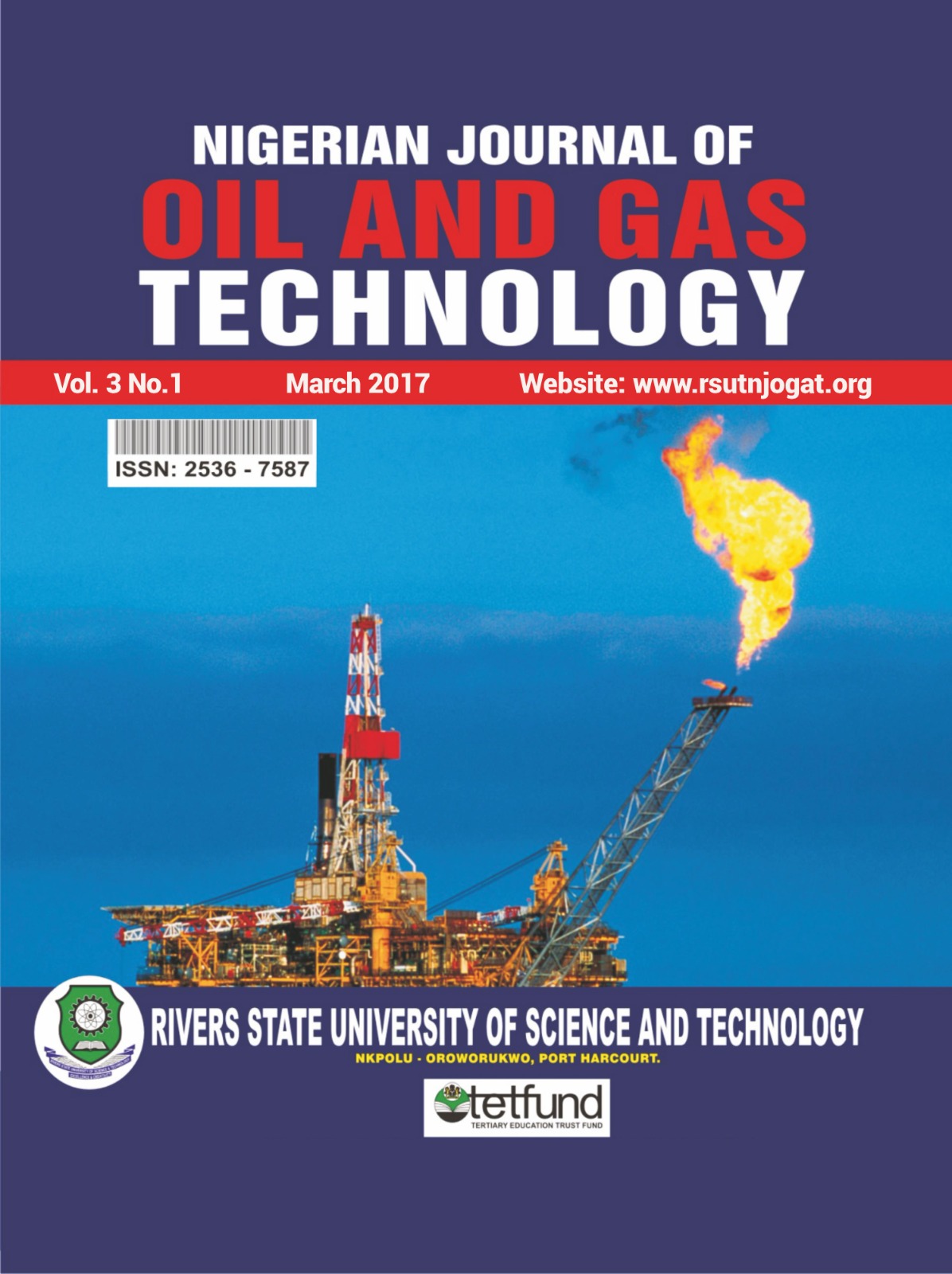
Bayelsa State, a region in the Niger Delta is characterized by accidents of spillages which affect both the fauna and flora of the area resulting in direct negative effects on the overall productivity potential of the area. The main objective of the study is to investigate oil and gas exploration, poverty and it's consequences on the people of Bayelsa State in Nigeria. The paper derived its data basically from secondary materials from textbooks, journals article, newspapers, through a systematic qualitative content analysis, using a theoretical framework of resource course as a tool for analysis. One major finding is that, there is absolute poverty due to environmental degradation, as a result of oil and gas production. We therefore, recommend adequate compensation for wherever there is oil spillage and provision of basic infrastructure for sustainable development.
Downloads
Literaturhinweise
Aderoju, O. (2007). Oil dependence and civil conflict in Nigeria. Benin: CSAE WPS/2007-09.
Adilieje, C. (2011). Public policy and environmental management in Nigeria. The Constitution Journal of Constitutional Development, 11, 85.
Afinotan, L. A., & Ojakorotu, V. (2009). The Niger Delta crisis: Issues, challenges and prospects. African Journal of Political Science and International Relations, 3(5), 191–198.
Aizenman, J., & Marion, N. (1993). Policy uncertainty, persistence and growth. Review of International Economics, 1(2), 145–163.
Azaiki, S. (2003). Inequities in Nigerian polities. Yenagoa: Treasure Books.
Barnet, J. R., & Muller, R. E. (1974). Global reach: The power of the multinational corporations (pp. 150–163). London: Jonathan Cape Ltd.
Caballero, R. J. (2000). Case of Caballero v. the United Kingdom. International Journal of Human Rights, 4.
Christa, N. B. (2008). Cursing the blessing? National resource abundance, institution and economic growth (p. 279). Oxford University Press.
Collier, P., & Hoeffler, A. (2000). Rebellion as a quasi-criminal activity. Journal of Conflict Resolution, 44(6).
Collier, P., & Hoeffler, A. (2004b). Conflicts. In B. Homburg (Ed.), Global crises, global solutions. Cambridge: Cambridge University Press.
Collier, P., & Hoeffler, A. (2004c). Greed and grievance in civil wars. Oxford Economic Papers, 56, 563–595.
Collier, P., & Hoeffler, A. (2005a). Democracy and resource rents [Mimeograph]. University of Oxford.
Collier, P., & Hoeffler, A. (2005b). Resource rents, governance and conflict. Journal of Conflict Resolution.
Collier, P., & Hoeffler, A. (2008). The causes of civil war: The false logic of Collier and Hoeffler. Journal of Conflict Resolution, 39(2), 262–275.
Collier, P., Elliott, V., Hegre, H., Hoeffler, A., Reynal-Querol, M., & Sambanis, N. (2003). Breaking the conflict trap: Civil war and development policy. Oxford: World Bank and Oxford University Press.
Dike, N. (1997). Understanding the multidimensional nature of poverty. Selected papers for the Nigerian Economic Society 1997 Annual Conference. Ibadan: Mag Press Ltd.
Dumming, T. (2005). Resources dependence, economic performance and political stability. Journal of Conflict Resolution, 49(4), 451–482.
Egbuche, U. (1998, July 26). Multinational corporation and social responsibility. The Guardian, p. 6.
Enogholase, G. (2000, October 22). Oloibiri: When the dancing stops. National Interest News-Paper, 1(10), 13.
Fearon, J. D. (2005). Primary commodities exports and civil war. Journal of Conflict Resolution, 49(4), 483–507.
Fearon, J. D., & Laitin, D. D. (2003). Ethnicity, insurgency, and civil war. American Political Science Review, 97(1).
Friedman, M. (1966). In C. O. Chukuezi (2009). Poverty and youth restiveness in Nigeria: Implication for national development. Ozeam Journal of Social Sciences, 2(2).
Gavin, M. C. (1977). A decade of reform in Latin America: Has it delivered lower volatility? Inter-American Development Bank Working Paper, No. 349.
Haysmann, R., & Rigobon, R. (2003). An alternative interpretation of the "resource curse": Theory and political implications. NBER Working Paper No. 9424.
Ibaba, S. I. (2005). Understanding the Niger Delta crisis. Port Harcourt: Amethyst and Colleagues Publishers.
Inokoba, P. K., & Imbuan, D. (2010). Vexation and military in the Niger Delta: The way forward. Kamla-Raj, Journal of Human Ecology, 29(2), 101–120.
Karl, M. T. (2001). Resource war: The new landscape of global conflict. Revista de Ciencias Militares, 3(2), November.
Karl, T. L. (1997). The paradox of plenty: Oil booms and petro-states. Studies in International Political Economy. University of California.
Lane, R. P., & Tornell, A. (1999). The voracity effect. American Economic Review, 89(1), 22–46.
Mahdavy, H. (1970). The pattern and problems of economic development in rentier states: The case of Iran. New York: Toronto Oxford University Press.
Naiman, N. (2014). ELF business and society. Business & the environment. What is the definition of oil drilling? Retrieved from http://www.eblow.com/about
Omofomnwan, S. I., & Odia, L. O. (2009). Oil exploitation and conflict in the Niger Delta region of Nigeria. Journal of Human Ecology, 26(1), 25–30.
Owate, I. O., & Okujagu, C. U. (1997). Introduction to energy and industrial environment. Ibadan: Rescue Publications.
Ramey, G., & Ramey, N. A. (1995). Economic volatility and economic growth. American Economic Review, 85(5), 1138–1151.
Sach, J. D., & Warner, A. M. (1995a). National resource abundance and economic growth. NSEK Working Paper No. 5398.
Wikipedia contributors. (n.d.). Hydrocarbon exploration. Wikipedia. Retrieved from http://en.wikipedia.org/wiki/Hydrocarbon_exploration