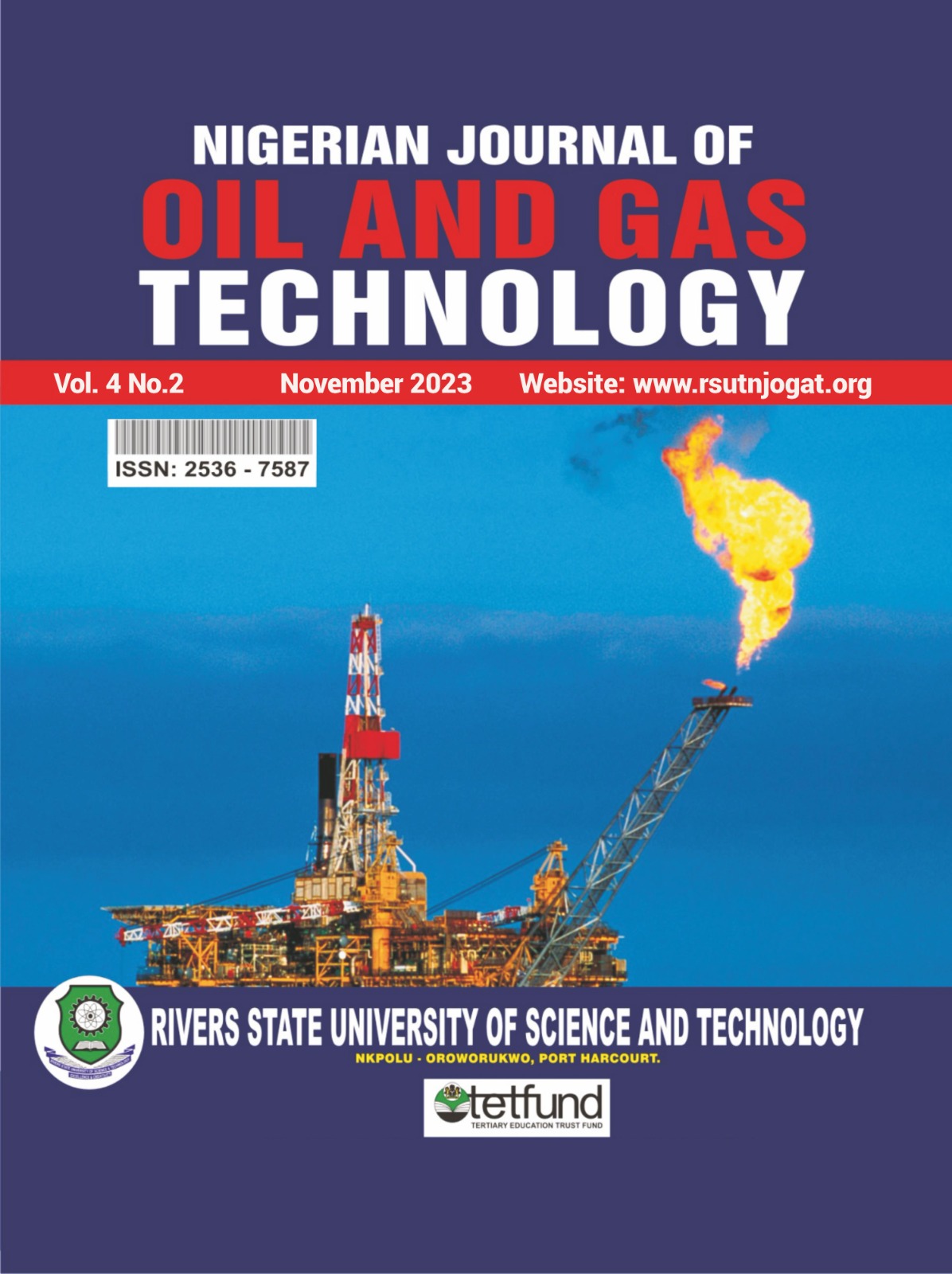
Perceptions of Vocational and Technical Educational Development in the Niger Delta Region: Implications on Pipeline Vandalism and Illegal Oil Refining in Urbanizing Port Harcourt and Environs.
Abstract
In the Niger Delta Region, urbanization is marked by an increase in crime, cultism, robbery, abduction, homicides, drug addiction, restiveness, pipeline vandalism, illicit refining, and other social vices, particularly among jobless youths. This study investigated the effects of vocational-technical education on youth empowerment in the region, with the goal of eliminating pipeline vandalism and illegal oil refining, thereby discouraging the exploitation of youths by influential individuals to perpetrate crimes such as kidnapping for money and rituals. A descriptive research design was adopted to achieve this objective. The study was guided by four research questions and corresponding hypotheses. A total of 6,003 youths from 12 public vocational-technical schools participated in the study. From this population, a sample of 400 youths was selected using the Taro Yamane formula for sampling distribution. Data were collected using a self-developed instrument titled Vocational-Technical Education for Youths Empowerment Scale (VTEYES). The instrument’s face and content validity were confirmed, and its reliability was tested using the Cronbach Alpha method, yielding a dependability coefficient of 0.72. Descriptive statistics (mean and standard deviation) were used to answer the research questions, while the null hypotheses were tested using the z-test at a 95% confidence level (α = 0.05). The study found that vocational-technical education contributes significantly to economic development, skill acquisition, and job creation in Rivers State. Although it may not directly result in poverty reduction, it has the potential to eradicate pipeline vandalism and illegal refining activities in Port Harcourt and its environs. The study recommends, among other things, the compulsory provision of facilities for vocational-technical schools, increased funding, and effective policy implementation.
Downloads
Literaturhinweise
Adeniye, B.A. (2016). The role of entrepreneurship education in vocational and technical education. Retrieved 13h January,
2016. Fromwww.adeconsultbloyspot.nl/2012/05/theroleof-entrepreneurship-education-inhtm.2m=o.
Anyaegbu, U. (2017). Enterprenueral skill acquisition and employment introduction. Retrieved on 24 October, 2017. Retrieved
from decnigeri.com/bulletin.php?
Asnul, D. M. and. Ruluzam, Y. (2010). Sustainable framework for technical and_vocational education in Malaysia. Journal oo
Procedia-social and Behavioural Sciences. } 1233 -— 1237. Retrieved 21st January, 2018, from _https://
www.sciencedirect.com/science/article/PIl/1877042810024171#
Baker, A. R. and Hanafi, 1. (2007). Assessing employability skills of technical-vocational skills in Malaysis. Journal of Social
Sciences 3(4), 202-207.
Beke, C. (2010) Speech on the Youth Restiveness and unfriendly business environment in Rivers State. Presented on 92.3
Nigerians Info, 16 August, 2010.
Bello, M. L.; Panuma, I. M. and Adamu, A.Y (2007). A survey of vocational training needs of 15 — 25 years old out — of -
schoof youths in Bauchi Metropoles. /nternational Journal of career and Technical education. (23)(1) 2007.
Retrieved27*January2018.F romhtips://cjournals. vt edu/J CTE/article/view/443/596.
Carlos, B. (2016). Youth entrepreneurship: Ottawa portfolio in talent development. Retrieved 16% November, 2016,
from https://timreviewcalarticle/394.
Echeonwu, C (2018). Vocational-Technical Education and Youths’ Empowerment in Rivers State. A Dissertation submitted to the
Department of Educational Foundations, University of Port Harcourt.
Encyclopaedia Britannia. Technical Education. Retrieved 2>¢ January 2018. From _http://www.bnitannica.com/topic/technical
education.
European commission (2017). What_is Entrepreneurship education? Retrieved 12'* November, 2016, from https//ec.europu.eu/
growth/smes/promoting- Entrepreneurship/support/education.
Fayemi, J. A. (2012) Youth Empowernment and poverty alleviation, the experience in Ogun State, Nigeria. Journal % Research in
National Development (10)(2). Retrieved from https://www.ajol.info/index.p p/jouned/article/viers/New 92 681)
Federal Republic of Nigeria (2001). National Youth Policy. Retrieved 6th September, 2017, from http://
www.thepresidency.gov.za/doc/policy/national_youth_policy.pdf
Federal Republic of Nigeria (2014). National Policy on Technical and Vocational Education. 6 Edition. NERDEC. Lagos.
Federal Republic of Nigeria (2014). Policy on Education. Lagos. NERDC Press.
Hoffman, F. (2015). Youth Economic Development Programme a formula for success. Retneved 10 January, 2017, from http://
www.devex.com/news/youth-economic-development-a-formula -for-success-856856.
Mohammad, B. (2014); Function of Technical and vocational education: an empirical study in Bushehr city. Journal of Social and
behavoural Sciences 143, 265-269.
National Bureau of Statistics NBS (2017). Unemployment Highest in Rivers State. Retrieved 11'* February 2018. From
www. businessnewsreport.com/ng/unemployment-highest-nvers-september-2017.
Obiefuna, C.A (7003). The _ school-industry linkage: An insight into the Technology curriculum of the Nigerian Universities.
Nigerian Journal of curriculum studies, 10(2), 255-258
Olajide, S. E (2015). Repositioning technical and vocational education towards eradicating unemployment in Nigeria.
International _ Journal of vocational and technical education. V7) (6). Retrieved 22:4 January 2018. From
www.academicjournals.org/journal/IJVTE/article-abstract/BSDAOICS’.
Princewill, T. (2017). Militancy, Kidnapping oil bunkering and murder are ill-winds that blows no good. Vanguard report of 25th
November, 2017.
Rivers State Ministry of Youths development, (2016): History of the Ministry of Youth Development. Retrieved 22"¢ October,
2017. From https//rivers state. net. ng /history/history-of-the-ministry-of-youth-development
UNESCO and ILO {2002). Technical and vocational education and training for 21st century. UNESCO and ILO
Recommendations. Retrieved 224 January 2018. From https://cjournals.lif.ut.cdu/JCTE/article/viers /443/596
UNESCO (2015). What do we mean by youth? Retrieved 10 January, 2016. From www.org/news/en/social-and-human-science/
themes/youths-definition/unesco (2002).
Williams, C. Kanen, B. Claudia, (2013) Maximizing the impact of youth entrepreneurship support in different contexts, Retrieved
on 17 November, 2016 from https://www.odi.org/projects/2557-maximizing-impact -youth-entrepreneurship-support-
different contexts.
World Bank ls. Press release on the Youth employment Needs urgent global action. Retrieved on
27/8/ 20 Vi romwww.worldbank.org/cnnas/press-release! 015/10/13/addressing-the-youth-emplyment-censes-needs-
urgent-global-action.